
What Is a Flood Zone?
A flood zone is an area identified by the Federal Emergency Management Agency (FEMA) as having a certain level of flood risk. FEMA uses flood maps to classify properties into different categories, ranging from low-risk areas to high-risk flood zones.Common flood zones include:- Zone X: Low to moderate flood risk
- Zone A: High-risk flood area
- Zone AE: High-risk area with established flood elevations
- Building requirements
- Permit needs
- Elevation standards
- Flood insurance requirements
First Step: Determine Where the Flood Plain Actually Is
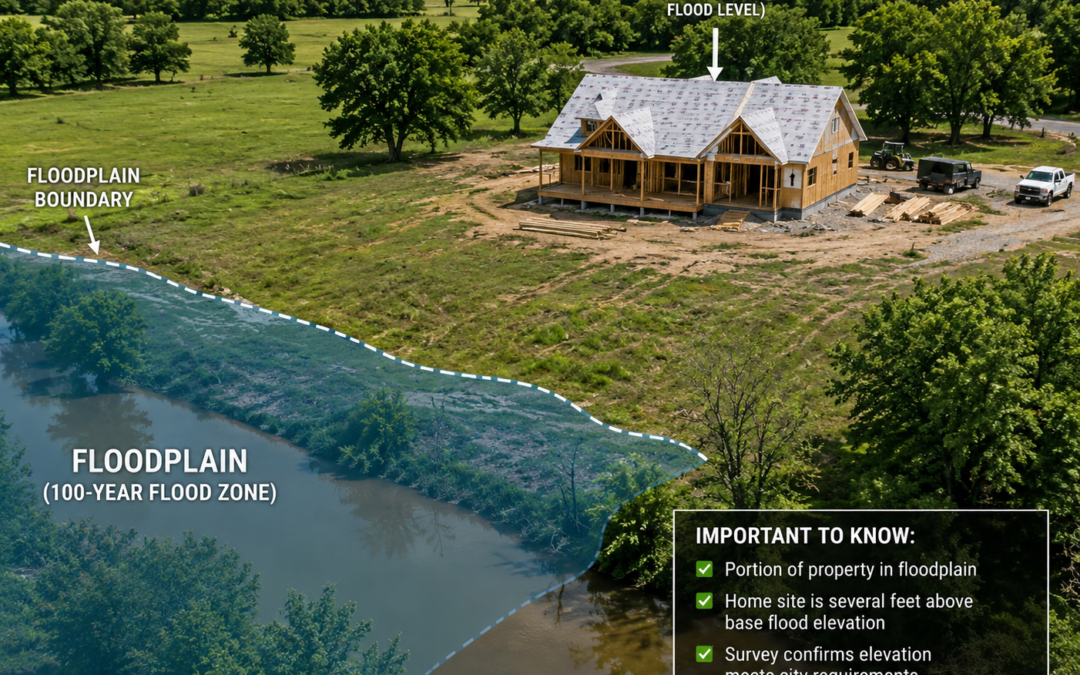
One of the biggest misconceptions about flood plains is that the entire property is unusable. In many cases, only a portion of the land falls within the flood zone.For example, on a five-acre tract, the flood plain may only affect a small section near a creek or drainage area, while the future home site could be located hundreds of feet away in a safe location.Because FEMA maps are generalized, it is important to verify the exact boundaries with a professional survey.Elevation Matters
Another key factor is the elevation of your proposed home site.Even if part of the property is in a flood plain, the area where you plan to build may sit several feet above the highest predicted flood elevation. This can make the property suitable for construction with the proper documentation.Many cities and counties simply require certification that the home will be built above the required flood elevation level. Some areas may require additional engineering or elevation surveys.Why You Need a Professional Land Survey
Before purchasing or building on land in a flood zone, it is wise to hire a licensed land surveyor.A surveyor can:- Identify flood plain boundaries
- Determine exact elevations
- Prepare elevation certificates
- Meet city and county requirements
- Help builders and lenders confirm the property is buildable
Real-World Example
We recently worked with a client whose land was located within a FEMA-designated 100-year flood plain. The city required certification showing the future home would sit at least two feet above the highest flood elevation.After completing an elevation survey, the surveyor discovered that the prepared home site was already four feet above the required level.The city approved the permit, and construction moved forward without issue.This is a good example of why flood maps alone should not determine whether a property is right for you.Risks of Buying Land in a Flood Zone
Like any real estate purchase, flood plain properties come with considerations:Higher Insurance Costs
Flood insurance may be required by your lender and can increase overall ownership costs.Potential Property Damage
Flooding can create expensive repairs if proper precautions are not taken.Additional Building Requirements
Elevated foundations, engineered pads, or other construction methods may be necessary.Permit Delays
Additional surveys and approvals can add time to the building process.Resale Considerations
Some buyers may hesitate to purchase homes located in designated flood zones.Potential Advantages of Flood Plain Properties
There can also be benefits to buying land near rivers, lakes, creeks, or open spaces.Lower Land Prices
Flood zone properties may sell for less than similar land outside flood areas.More Privacy
Less competition can provide opportunities to purchase larger tracts.Beautiful Views
Waterfront and creek-side properties often offer scenic surroundings.More Acreage for Your Budget
Buyers can often afford larger parcels of land.Buildable Opportunities
Many flood plain properties can still be developed safely with proper elevation and planning.Do You Need Flood Insurance?
If you obtain a mortgage and your home is located in a high-risk flood zone, lenders typically require flood insurance.Even if insurance is not required, it may still be a wise investment.According to FEMA, just one inch of floodwater can cause more than $25,000 in damage. Flood insurance can provide valuable protection for one of your largest investments.Don’t Let a Flood Plain Automatically Eliminate a Property
Flood plain properties require additional research, but they are not necessarily bad investments. The key is understanding:- The actual flood boundaries
- The elevation of the building site
- Local permit requirements
- Insurance costs
- Professional survey recommendations
Financing Land and Construction Loans in Oklahoma
If you are considering purchasing land or building a custom home, Spurr Mortgage can help you understand your financing options, including land loans and one-time close construction loans.Our team works with buyers throughout Oklahoma and can help you evaluate whether a property may be suitable before you move forward.Contact Spurr Mortgage
Jennifer Buffington Spurr Mortgage Corporation 233 E. 10th Street Plaza, Suite 3 Edmond, OK 73034
Five Choices That Can Change Your Custom Home Construction Budget
Five Choices That Can Change Your Custom Home Construction Budget A builder’s estimate is more than the total at the bottom of the page. The
Fannie Mae Manufactured Home Eligibility: Foundation, Utilities and Access
Fannie Mae Manufactured Home Eligibility A manufactured home can be a path to homeownership, but the home and property must meet financing requirements. If you
How Land Equity Works With a One-Time Close Construction Loan
How Land Equity Works With a One-Time Close Construction Loan If you already own the land where you plan to build, the equity you have
Construction Loan Builder Requirements in Oklahoma
Construction Loan Builder Requirements in Oklahoma A borrower may be financially qualified and the proposed home may appraise well, but a construction loan still depends
Construction Appraisals for Rural Land in Oklahoma
Construction Appraisals for Rural Land in Oklahoma Building a home on rural land can be an exciting opportunity, but before construction financing can be finalized,
Modular vs. Site-Built Homes in Oklahoma: Which Is Better?
Oklahoma homebuyers who plan to build often ask whether a modular home or a traditional site-built home is the better choice. Both methods can produce

Five Choices That Can Change Your Custom Home Construction Budget
Five Choices That Can Change Your Custom Home Construction Budget A builder’s estimate is more than the total at the bottom of the page. The

Fannie Mae Manufactured Home Eligibility: Foundation, Utilities and Access
Fannie Mae Manufactured Home Eligibility A manufactured home can be a path to homeownership, but the home and property must meet financing requirements. If you

How Land Equity Works With a One-Time Close Construction Loan
How Land Equity Works With a One-Time Close Construction Loan If you already own the land where you plan to build, the equity you have

Construction Loan Builder Requirements in Oklahoma
Construction Loan Builder Requirements in Oklahoma A borrower may be financially qualified and the proposed home may appraise well, but a construction loan still depends

Construction Appraisals for Rural Land in Oklahoma
Construction Appraisals for Rural Land in Oklahoma Building a home on rural land can be an exciting opportunity, but before construction financing can be finalized,

Modular vs. Site-Built Homes in Oklahoma: Which Is Better?
Oklahoma homebuyers who plan to build often ask whether a modular home or a traditional site-built home is the better choice. Both methods can produce

Five Choices That Can Change Your Custom Home Construction Budget
Five Choices That Can Change Your Custom Home Construction Budget A builder’s estimate is more than the total at the bottom of the page. The

Fannie Mae Manufactured Home Eligibility: Foundation, Utilities and Access
Fannie Mae Manufactured Home Eligibility A manufactured home can be a path to homeownership, but the home and property must meet financing requirements. If you

How Land Equity Works With a One-Time Close Construction Loan
How Land Equity Works With a One-Time Close Construction Loan If you already own the land where you plan to build, the equity you have

Construction Loan Builder Requirements in Oklahoma
Construction Loan Builder Requirements in Oklahoma A borrower may be financially qualified and the proposed home may appraise well, but a construction loan still depends

Construction Appraisals for Rural Land in Oklahoma
Construction Appraisals for Rural Land in Oklahoma Building a home on rural land can be an exciting opportunity, but before construction financing can be finalized,

Modular vs. Site-Built Homes in Oklahoma: Which Is Better?
Oklahoma homebuyers who plan to build often ask whether a modular home or a traditional site-built home is the better choice. Both methods can produce

